Alteryx Designer Desktop Ideas
Share your Designer Desktop product ideas - we're listening!Submitting an Idea?
Be sure to review our Idea Submission Guidelines for more information!
Submission Guidelines- Community
- :
- Community
- :
- Participate
- :
- Ideas
- :
- Designer Desktop
Featured Ideas
Hello,
After used the new "Image Recognition Tool" a few days, I think you could improve it :
> by adding the dimensional constraints in front of each of the pre-trained models,
> by adding a true tool to divide the training data correctly (in order to have an equivalent number of images for each of the labels)
> at least, allow the tool to use black & white images (I wanted to test it on the MNIST, but the tool tells me that it necessarily needs RGB images) ?
Question : do you in the future allow the user to choose between CPU or GPU usage ?
In any case, thank you again for this new tool, it is certainly perfectible, but very simple to use, and I sincerely think that it will allow a greater number of people to understand the many use cases made possible thanks to image recognition.
Thank you again
Kévin VANCAPPEL (France ;-))
Thank you again.
Kévin VANCAPPEL
A tool which allows to test multiple conditions in one place and create pipeline accordingly am talking about a router transformation tool in Informatica. This will allow a user to use one tool in places of multiple filters in today's scenario
Once you get the hang of it, Alteryx is great at producing reports. Unfortunately, each item has its own XML parameters, like font size, colors, table defaults, etc. As it stands now, if I want to make a change across the course of a complex, multi-page report, I have to update the settings in each table and chart.
I'd love it if I could have a 'Styles' module that I could set, then copy and paste and insert after each table. From that point, I suppose you could make parameters out of style options and build them into a bigger module. For now, though, some kind of reusable style would be invaluable.
When selecting an Action in the Summary Tool - like Count. The Output filed Name becomes Count. It s/b Filed Name_Count so I don't have to rename all the Output Field Names with a more descriptive name.
When city is not provided StreetGeocoder tool returns the first one in alphabetical order associated with provided ZIP code. For example, if you submit "380 New York St, 92373" the geocoder will return you "MARIGOLD, CA", instead of Redlands, CA which is the primary place name for 92373 ZIP code.
So if an address has multiple city names within the geocode table, can we provide the recommended city name?
In my current position, HDFS is used widely. Unfortunately, the current method for connecting (I believe JDBC) isn't as performant as other options out there. Would love to see bulk read/write options for HDFS, potentially using something like SQOOP.
We encountered an issue with clob data. Looks like alteryx is very slow performing while loading clob data to Oracle database. We need to figure a better way to handle the clob data.
As per title, add option to not write 0 records to output file i.e. don't create file with just headers, if 0 records end up streaming to the output tool
There are quite a number of XML configurations available in Alteryx Designer as well as in Alteryx server. And there are possibly in different locations and each of them them is specifically for different configuration options.
Currently, there it isn't a official list of all these configuration files as well as all the configurable options. It would be good to have a centralized area to configure and visualize all these. This not only helps easier to know how to customize the tool but also help easier to maintain the backup/restore of the configuration files.
Moreover, there are possibly some settings go into the registry. This would be also good to have this centralized as well.
Ideally, a user interface would be good for these configuration with general/advanced tabs to classify the possible configuration. For server, ideally, it could be comes up the controller to distribute all these settings. For Designer, once it is configured to the Gallery, it should be able to grab the configuration and apply in the machine.
Hope all these make sense and do-able.
Thanks.
Regards,
Kong
Constantly using rand() function but also need;
- Normal distribution function like we have in Excel and
- Triangular distribution function too...
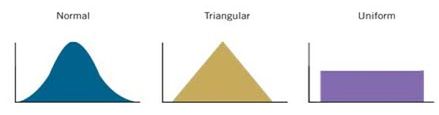
Idea: can we please add normdist() and triang(min,mode,max) functions...
Best
Edit: for normal dist. attached a discretized example...
I can see that the Venn diagram is very nice for a new user to understand the Join tool (which is a super-great tool by the way). But I would like to be able to close up the Venn diagram to give more room to see the variables listed below.
Thanks!
Susan
This is not a terribly important thing, but in the formula tool, the nitty gritty details of the Expression almost never fit into the annotation space. It would be nice if the annotation by default just contained the names of the variables being derived. So, e.g. if I'm deriving "CalcVar1", "CalcVar2", "CalcVar3" and so forth, the default annotation would just be:
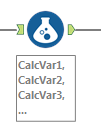
This gives a much cleaner (by default) canvas. The same concept applies to the MultiRow and MultiField Formula tools, perhaps others. Just a thought and obviously not very important. Thanks.
I find the concept of Batch and/or Iterative macros, when done specifically for the simple purpose of iteration, to be a fair bit of overhead. If we could extract the fundamental qualities of a loop and get that into an "Iteration Tool," it could become a well-used tool from the pallette.
Implementation Ideas:
- Assume that the iteration is over the rows of a given input data set.
- For the "body of the loop" allow multiple expressions, each of which iteratively assigns the i'th position of a given variable (which could be either existing or derived just like the Formula tool and it's expression).
- Allow referencing of the loop index variable from within expressions
An example problem this could solve is from: http://community.alteryx.com/t5/Data-Preparation-Blending/Looping-and-dynamically-changing-output/m-.... As discussed therein, the concept of "row dependent iteration" makes this difficult to solve with standard tools.
If the input data set from that example were sent into the proposed Iteration Tool... it would automatically loop over the dataset rows; and three expressions could be supplied in the Tool configuration to solve the problem:
VarE:   IF [i] > 1 THEN VarF[i-1] + VarG[i-1] ELSE VarE ENDIF
VarF:   VarA + VarB
VarG:   VarC + VarD
For implementation purposes, this would be logically equivalent to:
VarE[i]:   IF [i] > 1 THEN VarF[i-1] + VarG[i-1] ELSE VarE[i] ENDIF
VarF[i]:   VarA[i] + VarB[i]
VarG[i]:   VarC[i] + VarD[i]
(so, basically, the i'th row is assumed unless otherwise provided in the expression syntax).
I hope this isn't too outlandish - I've tried to think through how this could be accomplished (1) as a tool that is not too fiendishly difficult for Alteryx to implement and (2) which would also be easy for us, the end users, to utilize. Thanks!
Hello Alteryx,
In communicating with your agent Eddie Wong about a question (ref:_00DE0JJZ4._50044uMC7T:ref), he confirmed that Alteryx currently does not have an option to coalesce IDs when merging tables in the "Join" or "Join Multiple" tools. This functionality is available in SQL and SAS, for example.
This code demonstrates it.
data d1;
input ID age;
datalines;
1 45
2 36
3 77
;
run;
data d2;
input ID height;
datalines;
1 138
3 176
5 197
;
run;
proc sql;
select coalesce(d1.id, d2.id) as id,
d1.age,
d2.height
from d1
full join
d2
on d1.id = d2.id;
quit;
Could you please consider adding this option into the "Join" and "Join Multiple" tools?
I have many monthly financial reports in MS Word that is build up on the same structure (same headings, tables etc.). I would like to import those reports into Alteryx in order to structured and analyse the data in Alteryx and presenting later in Power BI.
A good solution might be a tool that read the word document and input one row for each paragraph, including some paragraph information like style (e.g. Heading 1, Heading 2, Normal, Punctuation etc.). Where there are tables in the document; several fields should be added and separated in Field 1, Field 2... in order to extract and analyse the content of each table.
Ref. also the discussion Input Data from Word document (.docx) and the idea Natively Support PDF as Input.
If you have a complex SQL query with a number of dynamic substitutions (e.g. Update WHERE Clause, Replace a Specific String), it would be nice to be able to optionally ouput the SQL that is being executed. This would be particuarly useful for debugging.
Is it possible to expand the filter function with an extra option to select a field with a filter definition in it. I want this so i can define a filter over multiple fields an type.
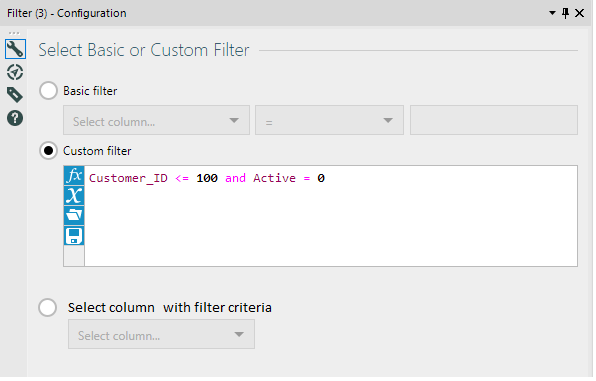
I saw that Carlos has made a similar macro (Click here).
To execute a filter saved in a record set i now have build a macro. this is how my macro looks like. nothing fancy but it does his job.
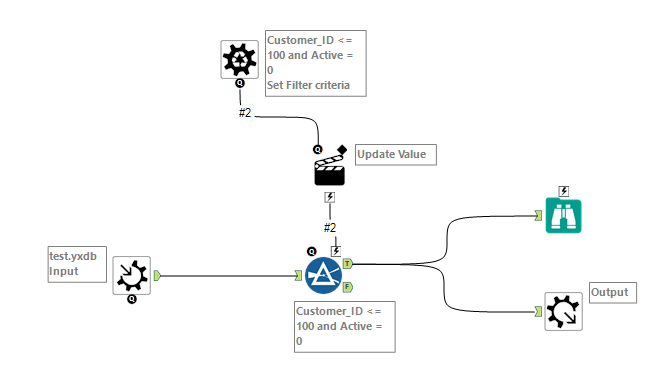
the macro is then called like this:
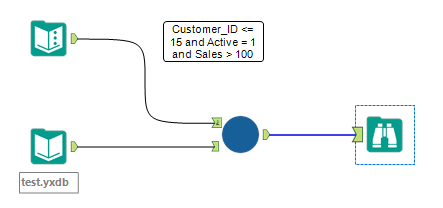
regards Humberto
US and Canada datasets are underlined so far but,
Alteryx is expanding towards, Denmark, Germany, France and several other countries...
The question is; Why don't we have Eurostat data provided as well?

Bulk options for some datasets are available.
Even one can get a grasp on micro datasets and Alteryx may have a deal inf this micro dataset is anonymized...


The summarize tool have drag drop facility and cross checking and suggestion on the type of aggregation that can be applied based on the data type.
e.g. Let there be two different stack. One to be used for Group By. Another for aggregation.
We should be able to drag fields to these sections.
Now when we are dragging something to the Aggregation stack, based on the data type, a small suggestion list of possible aggregation to choose from.
And a small validation of the data type to aggregation if we are defining the aggregation manually.
I can provide mock ups if anyone is interested.
 SeanAdams
am
05-31-2018
03:08 AM
SeanAdams
am
05-31-2018
03:08 AM
In a large enterprise - one of the key challenges is cleaning data in a consistent way. Many of the big EIM stacks have tooling for this which allows end users to create data cleanup rules, and the Microsoft version is called DQS (Data Quality Services).
Can we please add a connector to alteryx to allow us to drop a DQS cleaning tool onto a canvas - and then the 3 outputs will be
- data cleaned by DQS rules (managed by the data steward)
- error data that is invalid
- any status messages from the DQS call?
This would allow Line of Business users to build their own data cleaning rules consistently in one place, an lift this burden from the data analyst.
Thank you
Sean
I will sometimes open "New Window(s)" from a single or multiple Browse(s), and arrange them on a second monitor to dig through a module I am unfamiliar with, or when building out complicated models. It would be helpful if I could label these tempary new windows so that I don't spend to much time trying to remember which one is which.
- New Idea 395
- Accepting Votes 1.783
- Comments Requested 20
- Under Review 181
- Accepted 47
- Ongoing 7
- Coming Soon 13
- Implemented 550
- Not Planned 106
- Revisit 56
- Partner Dependent 3
- Inactive 674
-
Admin Settings
22 -
AMP Engine
27 -
API
11 -
API SDK
230 -
Bug
1 -
Category Address
13 -
Category Apps
114 -
Category Behavior Analysis
5 -
Category Calgary
21 -
Category Connectors
252 -
Category Data Investigation
79 -
Category Demographic Analysis
3 -
Category Developer
220 -
Category Documentation
82 -
Category In Database
215 -
Category Input Output
658 -
Category Interface
246 -
Category Join
109 -
Category Machine Learning
3 -
Category Macros
156 -
Category Parse
78 -
Category Predictive
79 -
Category Preparation
406 -
Category Prescriptive
2 -
Category Reporting
205 -
Category Spatial
83 -
Category Text Mining
23 -
Category Time Series
24 -
Category Transform
93 -
Configuration
1 -
Content
2 -
Data Connectors
985 -
Data Products
4 -
Desktop Experience
1.615 -
Documentation
64 -
Engine
136 -
Enhancement
421 -
Event
1 -
Feature Request
219 -
General
307 -
General Suggestion
8 -
Insights Dataset
2 -
Installation
26 -
Licenses and Activation
15 -
Licensing
15 -
Localization
8 -
Location Intelligence
82 -
Machine Learning
13 -
My Alteryx
1 -
New Request
229 -
New Tool
32 -
Permissions
1 -
Runtime
28 -
Scheduler
26 -
SDK
10 -
Setup & Configuration
58 -
Tool Improvement
210 -
User Experience Design
165 -
User Settings
87 -
UX
228 -
XML
7
- « Vorherige
- Nächste »
-
Carolyn
auf:
Blob output to be turned off with 'Disable all too...
- MJ auf: Add Tool Name Column to Control Container metadata...
-
fmvizcaino
auf:
Show dialogue when workflow validation fails
- ANNE_LEROY auf: Create a SharePoint Render tool
- jrlindem auf: Non-Equi Relationships in the Join Tool
- AncientPandaman auf: Continue support for .xls files
- EKasminsky auf: Auto Cache Input Data on Run
- jrlindem auf: Global Field Rename: Automatically Update Column N...
- simonaubert_bd auf: Workflow to SQL/Python code translator
- abacon auf: DateTimeNow and Data Cleansing tools to be conside...
| Benutzer | Anzahl |
|---|---|
| 7 | |
| 3 | |
| 3 | |
| 3 | |
| 2 |


