Alteryx Designer Desktop Ideas
Share your Designer Desktop product ideas - we're listening!Submitting an Idea?
Be sure to review our Idea Submission Guidelines for more information!
Submission Guidelines- Community
- :
- Community
- :
- Participate
- :
- Ideas
- :
- Designer Desktop
Featured Ideas
Hello,
After used the new "Image Recognition Tool" a few days, I think you could improve it :
> by adding the dimensional constraints in front of each of the pre-trained models,
> by adding a true tool to divide the training data correctly (in order to have an equivalent number of images for each of the labels)
> at least, allow the tool to use black & white images (I wanted to test it on the MNIST, but the tool tells me that it necessarily needs RGB images) ?
Question : do you in the future allow the user to choose between CPU or GPU usage ?
In any case, thank you again for this new tool, it is certainly perfectible, but very simple to use, and I sincerely think that it will allow a greater number of people to understand the many use cases made possible thanks to image recognition.
Thank you again
Kévin VANCAPPEL (France ;-))
Thank you again.
Kévin VANCAPPEL
It feels that lately Alteryx has been focusing on integration rather than adding more machine learning tools, which sadly are still not on par with many competing products...
Personally I miss having XGboost and multi-core random forest libraries like Ranger (along with a more robust implementation of C5.0).
What about you guys? Which R/Python libraries are you missing in Alteryx?
Hi!
It would be cool if the Overlap tool also worked with report layouts, instead of just the map image. For example, once I've pieced my different report tables into one layout, it would be cool if I could just add my company logo using image tool, add a Overlay tool, and add the logo to the top corner of my finalized report. I realized there are other ways of doing it, this would seem the most straight forward though. Just an idea.
In earlier versions the MongoDB Output did not pass fields with null values; this was ideal for storing individual attributes, where one person may have 4 attributes and another may have only 2 attributes, because we did not waste space storing empty or null values. The newer versions pass these fields with null values; I would like the option to not pass these fields. Please see an example below. Thank you for your consideration.
Workflow Results
| ID | Attribute1 | Attribute2 | Attribute3 | Attribute4 |
| 1 | A | B | C | D |
| 2 | Z | Y |
MongoDB Output Current Versions
{"_id" : "1",
"Attribute1" : "A",
"Attribute2" : "B",
"Attribute3" : "C",
"Attribute4" : "D"}
{"_id" : "2",
"Attribute1" : "Z",
"Attribute2" : "Y",
"Attribute3" : null,
"Attribute4" : null}
Desired MongoDB Output (previous functionality)
{"_id" : "1",
"Attribute1" : "A",
"Attribute2" : "B",
"Attribute3" : "C",
"Attribute4" : "D"}
{"_id" : "2",
"Attribute1" : "Z",
"Attribute2" : "Y"}
 patrick_mcaulif
It's really great that you guys have such clear communication about updates to the third party data, like CASS.
But, would you consider sending out those update emails to just the contact person for an organization?
We are trying to keep all of our users in sync on the same versions of CASS and US Data; and the email blasts have caused some confusion. Not to mention too that our IT security policy is to not download zips/exe's from the web. We have a centralized way to bring it in, prep the download, and make available all at once to keep everyone up to date.
Teradata has a feature called query banding where a group of queries or more commonly a database session can have additional metadata tagged onto all of the individual queries. The Teradata workload management engine can use information provided in the query band for use in prioritizing query execution and resource allocation.
With normal input tools, the query band information can be populated in the "Pre-SQL" with a query such as:
SET QUERY_BAND = 'org=Finance;report=Fin123;' FOR SESSION;
However, with the In-DB tools, there is no concept of pre-SQL, and no great way to set the query band for the In-DB queries Alteryx submits. We would want to set the query band at the workflow level for performance prioritization and resource allocation monitoring purposes.
Best regards,
Ryan
It would be great if we could make use of HTML5, in the same way the new formula tool will, by enabling autocomplete in all relevant tools - Filter, Multi-Row/Multi-Field Formula etc...
All the tools in the interface should be populated and assigned/selected with dynamic values.
Now we have the option of populating a set of values for Tree/List/Dropdown.
But we do not have the selecting some of them by default / while its loading.
And Other controls like TextBox/NumericUpDown/CheckBox/RadioButton also should be controlled by values from database.
For example If I have a set of three radio buttons, I should be selecting a radio button based on my database values while the workflow loading.
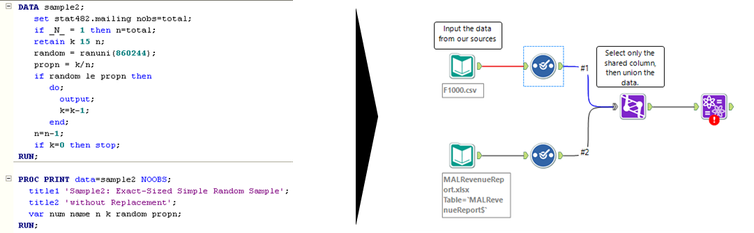
I'm wondering about migrating from SAS DATA STEP to Alteryx tools and R...
Idea is to parse DATA STEP, replace data loading, preperation, filetring, formula and iterative flows with native Altryx tools and
for the rest, PROC's etc will be replaced by R packages... Wouldn't that be like magic?
Would it be possible to add some additional options to the running total, in particular average (max, st dev. may be useful) to the running sum tool or create a rolling average tool where you can group by multiple fields and have a rolling window for the last x rows, which you select? I know this can be done in the Multi-Row formula and with the moving summarise tool tool (http://www.chaosreignswithin.com/2014/12/moving-summarize.html), however the former is capped by 10,000 rows and alteryx crashes on my mac when trying to click on the multi-row formul tool with 6000 rows. Also it takes a several hours to analyse 1 file, and would like to have a solution to do this on a daily basis. Also I need to be able to so a rolling average over the last 11,999 rows, as this would be the last 20 minutes of data using a 10Hz GPS unit. This would be a great tool I think.
Improve Help Documentation or in-tool options for handling null values in statistical tools like Weighted Average or Linear Regression. For instance, checkbox to remove null value records, or at least warn users.
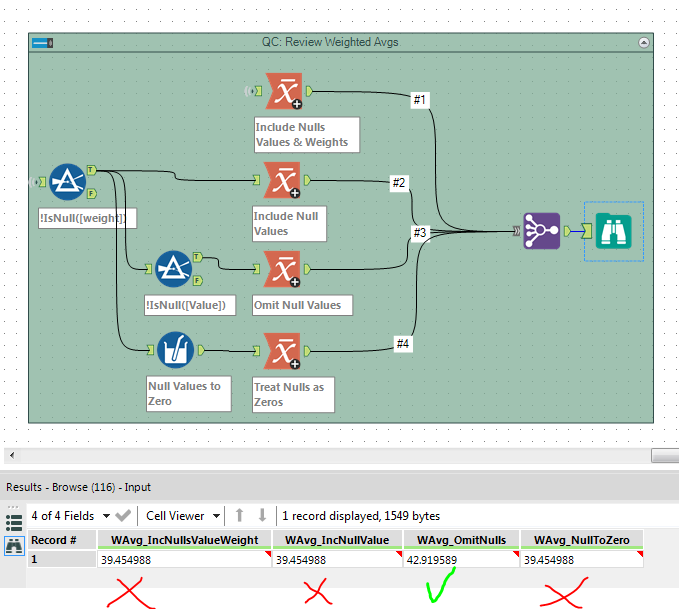
In the processing of learning to perform linear regression in RStudio and Alteryx, I came across differing outputs depending on how null values were addressed. Take the Weighted Average tool for example.
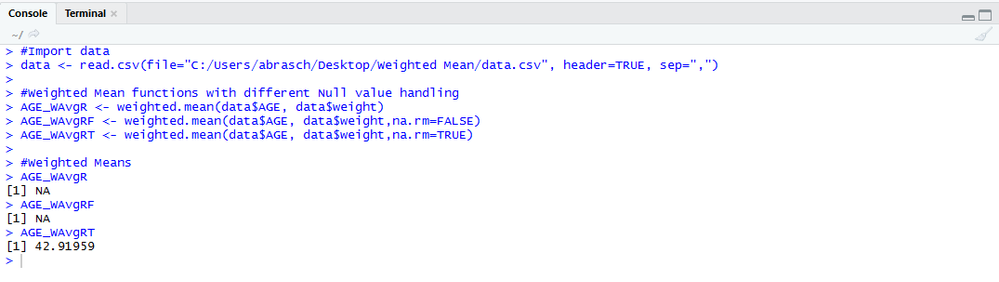
In R, the weighted.mean function treats null values in the variable of interest as if they were not there. If the user does not specify that null values exist, the result is NA. If any null values exist in the weight field, the result is NA.
Since I am more familiar with Alteryx, I originally did the data preparation—including calculating the weighted means—in Alteryx. When comparing these weighted means with those generated in R, I found that Alteryx treats the null values as zeros (i.e. includes them in the calculation). The user would have to know this is incorrect and first filter out the null values. See screenshot examples.
This is also the case within the Linear Regression tool. If null values are not omitted prior to regression, the results are wildly different. Perhaps this is known by more experienced users/statisticians, but this incorrect usage would have gone on unbeknownst to be had I not cross-checked with RStudio.
Could you please add a second/separate opacity setting for polygons? Many times I'd like to have a solid border around a trade area, but with about a 50% opacity setting for the fill.
Thanks!
With the allowance of personal use coming I would love to see Alterxy create a free 'Community Edition'. In my mind this would be a free version of Alteryx (similar to the Tableau Public App) with a few key limitations to the product, such as only allowed to connect to a local file, no download tool, only output to local files can only save to the gallery etc.
This would mean people who cant access Alteryx through work (or can't afford to purchase it for themselves) can learn, develop and share. It also means that when a user comes to deliver a POC they have a bit more experience than just the 14day trial period
It seems Alteryx does not have option to add metadata while adding the S3 object using S3 data connector. It has to be done using REST API calls via download tool or via javascript tool. As S3 is widely used now to store large files it would be handy to be add the functionality to add or extract metadata via S3 connectors.
It will also be useful if S3 connectors accept a field name in the object name instead of hardcoding the name or path.
You should at least have the option to output datetime in a datetime datatype from the DateTimeNow component. Currently it outputs a string so you have to use another component to parse the datetime to datetime datatype.
Reduce mouse movement required by bringing up the "Add" menu at the point of the cursor when right-clicking on a field in the Fields window.
Would like to see a conversion function that will deliver a Date value when the day, month and year values are in separate fields:
ToDate([Year],[Month],[Day])
It would be ideal if the input values could be either string or numeric.
Hi,
Am I the only one that finds it frustrating that when you are summarising values by dates that all the natural sorting is lost. A good example is using the DateTimeFormat function to strip out the days so that you can get monthly totals but this is then saved as a string so time-related ordering is then lost. Is it possible to add the ability to summarise by time periods (weeks, months, quarters, etc....) and for the natural progression of time / days to be maintained as I am constantly having to reinvent the order.
In addition, it would be useful if we could extend this to provide time-based running totals so for example one tool could be configured to point at transaction data (date & value) and would automatically summise the Jan value and then monthly year to date value by period (selected as weekly, monthly, etc...) up to the max date value in the dataset.
Just a thought,
Peter
I'd like a simple option to zoom to the full extent of my module, showing all the tools centered on the canvas.
Thank you.
An additional feature would be to have Alteryx be able to auto-arrange or clean up the canvas tools, specifying a mimum distance between tools and reducing connector overlaps.
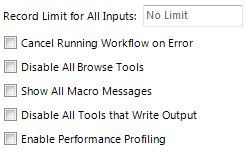
I find that each time I create a new Workflow, I have to go into the "Workflow - Configuration" and update to the settings I would like even though they are usually consistent.
Usually this is checking the "Cancel Running Workflow on Error" box (so if I am connected to Salesforce and my Password or Security Key changes it will not lock me out by continuing to connect as well as letting me know right away if there is an error)
If there was an option to save different Workflow Settings (so we can name them based on their use) for different purposes so when anyone presses "New Workflow" they can choose a specific one to work from - important to have a default one that is used most (Sometimes it's nice to have Horizontal - other times Vertical | Sometimes we want annotations, other times we don't).
We have a large number of apps which are used by a substantial number of end users. One frequent end user complaint is that forms do not persist, i.e. the settings need to be reselected each time the form is run. We've heard that this is an Alteryx issue. Are there any solutions or work-arounds? It is a huge ease of use issue. It has occurred to me that we may need to dramatically simplify the forms (they have many controls) but I would like to have a solution that is correct in terms of complying with modern Web UI standards. I remember pushing to make forms persistent twenty years ago.
- New Idea 395
- Accepting Votes 1,783
- Comments Requested 20
- Under Review 181
- Accepted 47
- Ongoing 7
- Coming Soon 13
- Implemented 550
- Not Planned 106
- Revisit 56
- Partner Dependent 3
- Inactive 674
-
Admin Settings
22 -
AMP Engine
27 -
API
11 -
API SDK
230 -
Bug
1 -
Category Address
13 -
Category Apps
114 -
Category Behavior Analysis
5 -
Category Calgary
21 -
Category Connectors
252 -
Category Data Investigation
79 -
Category Demographic Analysis
3 -
Category Developer
220 -
Category Documentation
82 -
Category In Database
215 -
Category Input Output
658 -
Category Interface
246 -
Category Join
109 -
Category Machine Learning
3 -
Category Macros
156 -
Category Parse
78 -
Category Predictive
79 -
Category Preparation
406 -
Category Prescriptive
2 -
Category Reporting
205 -
Category Spatial
83 -
Category Text Mining
23 -
Category Time Series
24 -
Category Transform
93 -
Configuration
1 -
Content
2 -
Data Connectors
985 -
Data Products
4 -
Desktop Experience
1,615 -
Documentation
64 -
Engine
136 -
Enhancement
421 -
Event
1 -
Feature Request
219 -
General
307 -
General Suggestion
8 -
Insights Dataset
2 -
Installation
26 -
Licenses and Activation
15 -
Licensing
15 -
Localization
8 -
Location Intelligence
82 -
Machine Learning
13 -
My Alteryx
1 -
New Request
229 -
New Tool
32 -
Permissions
1 -
Runtime
28 -
Scheduler
26 -
SDK
10 -
Setup & Configuration
58 -
Tool Improvement
210 -
User Experience Design
165 -
User Settings
87 -
UX
228 -
XML
7
- « Previous
- Next »
-
Carolyn
on:
Blob output to be turned off with 'Disable all too...
- MJ on: Add Tool Name Column to Control Container metadata...
-
fmvizcaino
on:
Show dialogue when workflow validation fails
- ANNE_LEROY on: Create a SharePoint Render tool
- jrlindem on: Non-Equi Relationships in the Join Tool
- AncientPandaman on: Continue support for .xls files
- EKasminsky on: Auto Cache Input Data on Run
- jrlindem on: Global Field Rename: Automatically Update Column N...
- simonaubert_bd on: Workflow to SQL/Python code translator
- abacon on: DateTimeNow and Data Cleansing tools to be conside...
| User | Likes Count |
|---|---|
| 7 | |
| 3 | |
| 3 | |
| 3 | |
| 3 |


