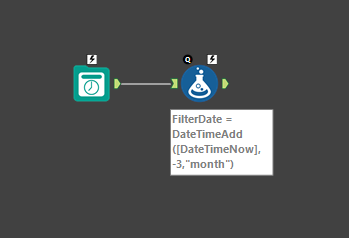
You can use the DateTimeNow input and DateTimeAdd function to create your filter date, and then either append it to all of your data and run a filter, or feed the resulting filter date into a filter node contained within a macro. The append can be expensive with a huge amount of records, but complexity vs speed is dependent on your data set.
Basically, just use DateTimeNow to get the current date, then use DateTimeAdd([DateTimeNow], -3, 'month') to get a date that is 3 months ago. After that, either append it to your data and compare the new FilterDate with the existing date column, or feed it into a batch macro as a control parameter (and having that control parameter replace part of a filter equation) before running your data through the macro.
If that's unclear, let me know and i'll build out a better example!
I know this is a somewhat aged query - but I had this issue and the thread came up while searching for an answer. Adding this at the end of the SQL query worked for me:
To_Date(To_Char(REPORTING_PERIOD), 'YYYYMM') Between Trunc(Add_Months(SysDate, -3), 'MM') And Last_Day(Add_Months(SysDate, -1))
This gave me a rolling three months, and shows the complete months prior to the date the workflow is run - so if it's run mid February, I get November, December and January data. Additionally, my users don't them have to change dates in the workflow (which has led to issues previously).