Hi all,
I have a data-set with relationships that is best described with the following example:
When a user installs an app, a unique user-id is generated.
Each time the user uses the app, a unique session-id is generated.
For each session of the user, every screen the user visits is recorded together with some other information.
So the raw data could look something like so:
| User | Session | Screen |
| Alpha_123 | Ses_1 | f1 |
| Alpha_123 | Ses_1 | f2 |
| Alpha_123 | Ses_1 | b1 |
| Alpha_123 | Ses_1 | b2 |
| Alpha_123 | Ses_1 | e1 |
| Alpha_123 | Ses_2 | f1 |
| Alpha_123 | Ses_2 | e1 |
In the data-set, all information beside what I showed in the table above is initially on the "Screen"-level, information could for instance be time of day, date etc.
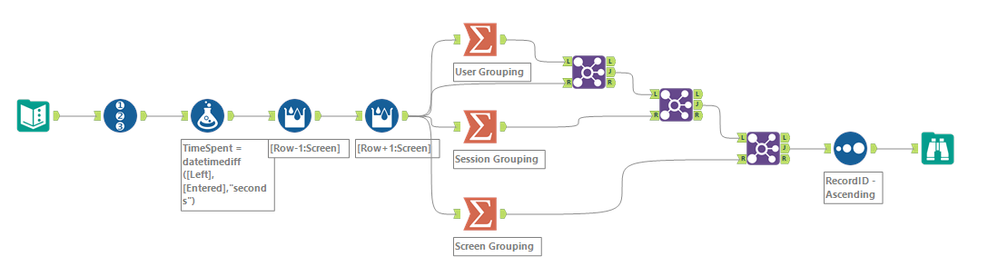
Now, I have made a flow where, in PowerBI, I have the opportunity to view information both on a user level (For instance how many purchases did a specific user make), a session level (For instance at which time of the day does most session take place) and at screen level (For instance, showing how a user moved through screens with how long time spend on each screen).
My problem is that the current model was made in many iterations and is therefor quite fragile, so my question is:
What are the best practices, when designing a flow for multiple levels (here three) where detail levels of all three levels must be conserved?
My initial idea was to simply split my input file into 3, and then export 3 tables to PowerBI.
I would like to hear your thoughts, perhabs explained with a couple of examples.
BR Mikkel 🙂