It's been around a month since we all gathered in London to build our Public Sector community and try our hands at solving some climate related data challenges with Alteryx. Here I will share some reflections and discuss some of the workflows that were built on the day. Firstly I'm still delighted that every team was able to achieve a really nice, presentable solution in little over an hour – with skills ranging from the totally new to the experienced! A testament to Alteryx meeting you where you are on your analytics journey showing the strength of collaboration in the community with advanced Alteryx users being more than happy to let others drag and drop and develop their skills.
In this post I'll highlight some of the outputs from the workflows which I think cover a breadth of interesting features and uses of Alteryx Designer. But first let's first start with a quick recap of the data we had to work with for the Hackathon. We used the publicly available:
- Energy performance certificate data.
- Energy performance certificate recommendations
- The spatial maps for the census areas (LSOAs)
- Postcode table for lookups to get the latitude and longitudes.
I'll attach the fact sheet to this blog post for those who want a refresher and a link out to the source data too!
Highlights
Spatial
The first output we'll take a look at is from Team 2's workflow which made use of the spatial tools for analysis and the reporting tools for generating maps. This kind of spatial analysis is great for identifying areas or communities that have the most to gain by a retrofit. Let's look at their combined savings map!
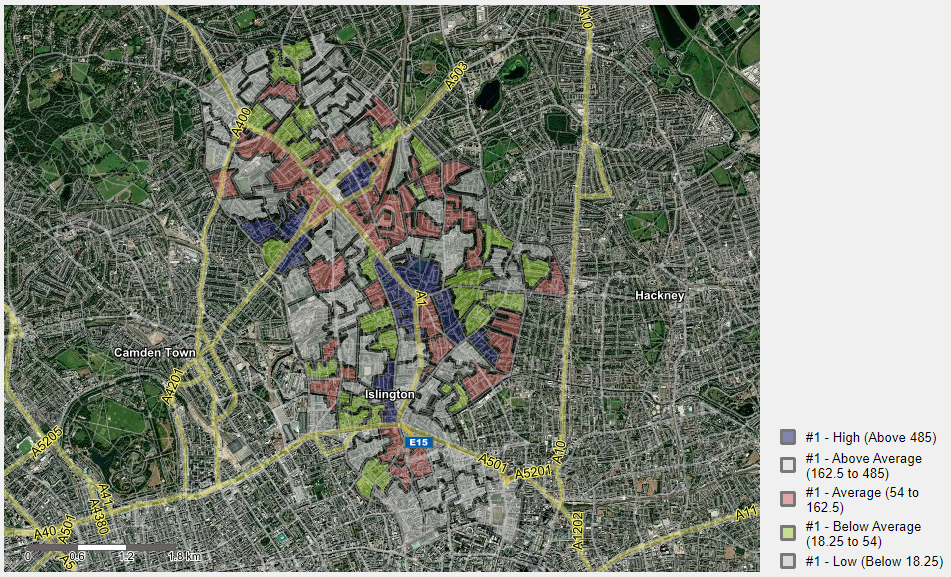
I think one of the most powerful aspects of these kinds of maps is it lets people immediately see where there is an area of highest potential savings for residents. This can lead directly to some action on engaging at an individual home level in that area and interacting with residents to see if they perhaps need support or encouragement in retrofitting.
Assisted Modelling
The second outcome is from team 3 who used the predictive capabilities of the assisted modelling tool to predict the potential cost savings based on the current energy band rating of a household. The team had never used the assisted modelling tools before and had minimal data science experience but following through the intuitive wizard for feature selection and cleaning up values, the assisted modelling tool suggested that they use a decision tree model for the best results - let's see those results below!
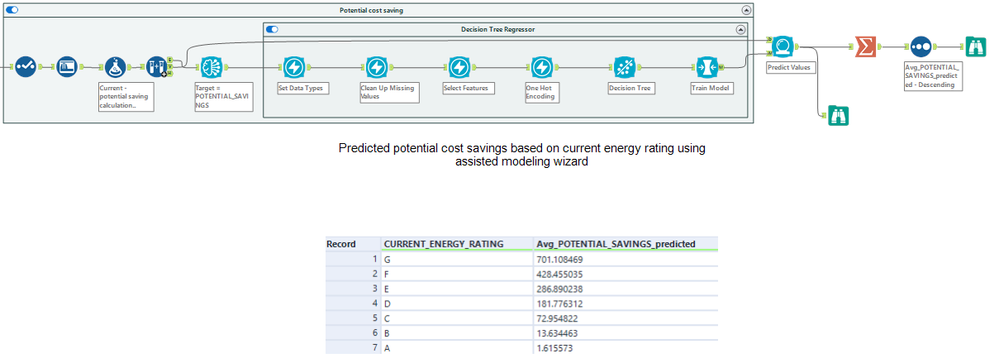
What may have been subjectively intuitive - that the lower the current energy rating the higher the potential savings - we've now quantified with a machine learning model. This can be used to inform which households to target with retrofit support!
Text Analysis
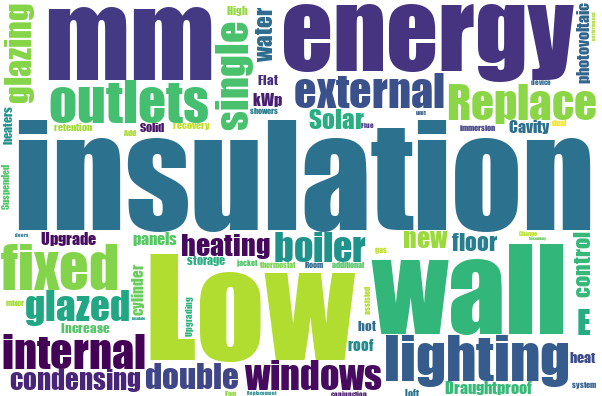
My final highlight for this blog post is one from Team 4. This was a group who had no prior Alteryx experience at all and they easily shared an informative word cloud with everyone. To achieve this, they took the recommendations text and used the text mining tools from Intelligence Suite to generate this insight to spark conversation and ideas around retrofit challenges and opportunities.
Approaches
These are just a few of the fantastic outcomes achieved by all the teams. It was inspiring to see how each team approached the challenge and how their thought processes and creativity progressed throughout the session.
Each team kicked off with initial exploratory analysis, looking into the data for columns that needed to be cleaned or other useful columns they could use and formatting them appropriately. They then progressed to feature generation and data enrichment through calculating the total potential savings from lighting and heating. From there, each team really forged their own path for their analysis - coming up with creative ways to investigate the data and extract useful insights that could inform impactful decisions fast.
The Workflows
You can download all of the source data and team’s workflows from our drop file share here –> workflows
Conclusion
I'm still in awe at what everyone was able to achieve in an hour and I can't wait for us to do something like this again in the future! Please leave comments below on any suggestions you have for a future event, datasets, challenges or maybe we can do a bring your own data hackathon. The Alteryx public sector community is for all of you. We want you to succeed so we‘ve created this space for you to share your experiences, collaborate on your Alteryx challenges and solutions and hear about all the amazing events and knowledge we can share with each other.
Calum


