Recently a couple of customers turned on AMP on Server and migrated the majority of the workflows to use AMP. While the promise is very simple „AMP provides significant performance and efficiency improvements over the original Engine“ (link) – the results look very different in reality. We have noticed a significant (actually dramatic) decrease in performance.
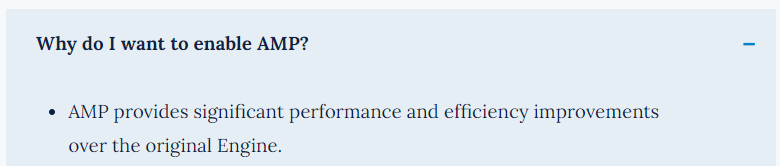
(screenshot from the SERVER documentation)
I was able to also verify this when testing it on my private server and the reason is very simple: While AMP will increase the performance of a single workflow significantly, it doesn’t do this very efficiently. And this is a false claim by Alteryx stated in the documentation.
I have a 10-core server – therefore I was able to run 5 workflows in parallel on a server with the old E1 engine.
I used a sample workflow that roughly took 10 minutes with E1. Using the E1 setting, it would take 10 minutes to execute this workflow five times.
Switching the workflow to AMP resulted in a great performance increase and took down the time of execution to only four minutes – but it was the only thing running. When running it five times… it takes 20 minutes instead of 10 and therefore decreases the performance by 50%.
The difference became even bigger as soon as we were dependent on internet speeds and interface response times. In many workflows, a lot of time is taken by the Read/Write of files / APIs / DB. For example, let’s assume we have a workflow that simply grabs data from an API and saves it to a database.
The API doesn’t run faster at all when querying it with AMP – the same as the DB when writing it. In these extreme scenarios, this leads to a performance decrease of 80%. This might be an extreme example (that we actually have on many customers), but the premise is the same: As long as read/write are the major time eaters in our workflows, AMP is not a good idea to be used – especially when put on the server.
My friends (who pointed me to this in the beginning) asked me to open this up here as a discussion-starter about AMP and core efficiency as it seems, that Alteryx claims about "efficiency" aren't correctly stated in the documentation or "efficiency" doesn't mean "CPU core-efficiency" and "significant performance improvements" does only mean "single workflow performance improvements" and not "overall performance improvements".
In one of the cases, this became a huge problem. The customer was running his Alteryx server at 90% load factor over the whole week span. Now ... they can't run all the workflows anymore and had to go back to the pre-AMP migration version of it in order to run their business successfully. 100s of hours were wasted optimizing and changing the workflow to be "AMPed" properly and it didn't result in the desired improvements.
I'd hope that we can get some clarification on what Alteryx means by "efficiency" and "performance improvements" as it seems, that this isn't universal and customers are misled by these promises in the server "AMP Engine Best Practices" guide.
Best
Alex


